
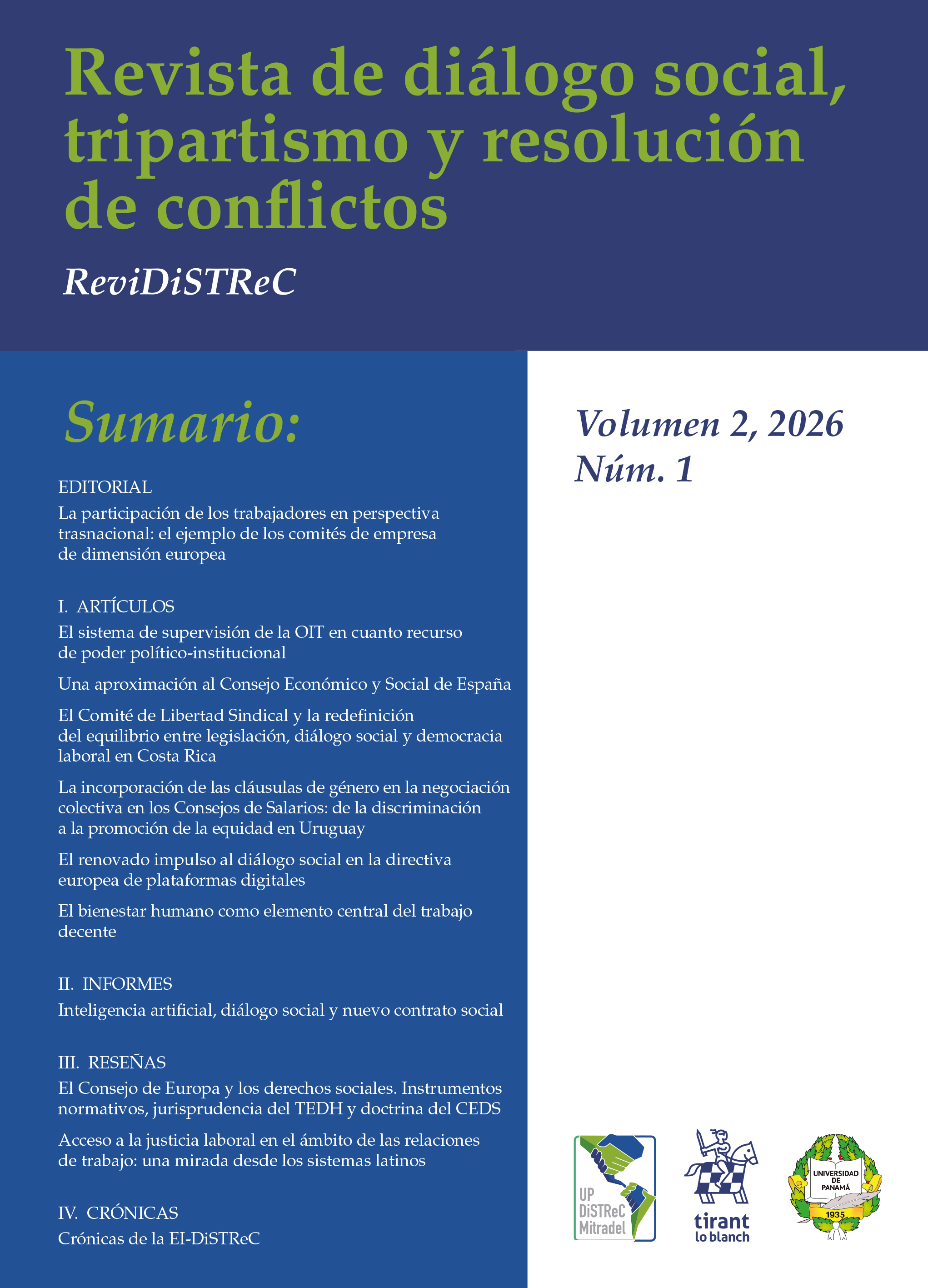
Published 2026-01-30
Keywords
- Decent work,
- wellbeing,
- dignity,
- democracy,
- labour law
- ILO ...More
How to Cite
Abstract
Well-being is a general objective of public interest that has been reflected in the values of the modern State (based on rule of law and known as Welfare state) since the dawn of the 20th century. The concept has been incorporated into various human rights Declarations and Pacts, as well as into labour law (both national and international).
Well-being seeks to guarantee the dignity of the individual, which in the world of work is reflected in what the International Labour Organization (ILO) has defined as Decent work. This concept, adopted by the Organization in 1999, is inclusive and constantly evolving, and its implementation requires combining aspects relating to rights, employment, protection and dialogue into a whole. It is also a goal, a framework for defining and implementing policies, a method of organizing activities and programs, and a platform for partnership with other entities.
The changes experienced by society and this broad definition of Decent work are reflected in the ILO’s own activities, text and programs over the last 25 years, where health and general well-being (individual and social) are seen as its fundamental objective. Evidence of this can be seen in the International Standards adopted during this period, which demonstrate the changes and relevance of this evolution. The incorporation of healthy and safe working conditions into fundamental rights at work is the most obvious example.
The world has evolved and faces great challenges, and only a shift in focus towards guaranteeing well-being through decent work can lead to social peace and, ultimately, social justice.
Downloads
References
- Bisquerra Alzina, R. (2013): Cuestiones sobre el bienestar. Madrid, Síntesis,
- Baylos Grau, A. (2016). Sobre el Trabajo Decente: La Formación Del Concepto. Derecho & Sociedad, (46), 15-24
- Casanova. F (2002) Boletín técnico interamericano de formación profesional Nº 153. Formación profesional, productividad y trabajo decente, Montevideo. Cinterfor OIT.
- Habermas, J. (2010). El concepto de dignidad humana y la utopía realista de los derechos humanos. Diánoia, 55 (64).
- Levin, L. (1998) Derechos Humanos. Preguntas y respuestas. Ediciones UNESCO.
- Naciones Unidas (2015) La Agenda 2030 para el Desarrollo Sostenible. OIT .
- Organización Internacional del Trabajo OIT (1999) “Trabajo decente”, Memoria del Director General. 88a Reunión de la Conferencia Internacional del TrabajoGinebra. Junio
- OIT (2000). "Reducir el déficit de trabajo decente. Un desafío global". Memoria del Director General, OIT, 89ª Reunión de la Conferencia Internacional del Trabajo, Ginebra.
- OIT (2017). Informe Mundial sobre la Protección Social 2017–2019: La protección social universal para alcanzar los Objetivos de Desarrollo Sostenible. Ginebra: OIT.
- OIT (2019). Trabajar para un futuro más prometedor. Comisión Mundial sobre el Futuro del Trabajo. Ginebra. Enero
- OIT. (2024). El trabajo decente y la economía del cuidado. Conferencia Internacional del Trabajo, 112.ª Reunión. Ginebra.
- OIT. (2024). Resolución relativa al trabajo decente y la economía del cuidado. ILC.112/Resolución V. Conferencia Internacional del Trabajo, 112.ª reunión. Ginebra
- OIT (2025). Empleo, derechos y crecimiento: fortalecer el nexo. Memoria del Director. Conferencia Internacional del Trabajo 113.a reunión.ILC.113/IB
- Sen, Amartya y Martha C. Nussbaum (comps.). (1993). La calidad de vida. México: Fondo de Cultura ECONOMICA
- Supiot. A. (2021) Homo faber: continuidad y rupturas, en el Derecho del trabajo en la Actualidad, Revista Jurídica de Buenos Aires, año 46, número 102, Facultad de Derecho, Universidad de Buenos Aires.